Bull Lake Cabin in Troy, Montana

Most Montana lake cabin searches lead to the same crowded destination.
Flathead Lake. Whitefish Lake. The Glacier corridor. These are the lakes that appear first in search results, first in Montana tourism marketing, and first in the mental map of most travelers who have never been to the state before. They’re genuinely beautiful. They’re also the lakes where “private” is a relative term — where the shoreline has been developed for decades, where your nearest neighbor is a hundred feet away, where the water fills with motorboats on summer weekends, and where “secluded” means you can’t quite see the marina from your deck.
Real private lake cabins in Montana require looking past the first page of results. They exist — and in the northwestern corner of the state, they deliver a version of the Montana lake experience that the famous lakes can no longer provide at any price.
This guide is for travelers who specifically want the private Montana lake cabin experience — not a cabin near a lake, not a cabin with a view of a busy lake, but a cabin on a lake where the water is quiet, the shoreline is yours, and the surrounding landscape feels like Montana at its original scale.
For the full comparison of Montana’s major lake vacation rental destinations, see the Montana Lake Vacation Rentals guide →
What Makes a Montana Lake Cabin Genuinely Private
“Private” in Montana lake cabin listings can mean many things — and most of them fall short of what the word suggests. Before comparing specific destinations, it’s worth defining what genuine privacy at a Montana lake cabin actually requires.
True Privacy: The Five Conditions
1. No neighboring structures in the sightline from the water. If you can see another cabin, dock, or structure from the end of your dock or from the water’s surface, your lake experience is shared whether or not you interact with the neighbors. True privacy means the only things visible from the water are forest, mountains, and sky.
2. No shared shoreline access. Community beaches, shared dock areas, and HOA-managed waterfront access mean other people are using your waterfront on their schedule. A genuinely private cabin has a stretch of shoreline that belongs to the rental for the duration of the stay.
3. Minimal boat traffic on the water. A lake with constant recreational boat traffic is not a private lake experience regardless of how secluded the cabin feels. The sound and presence of passing watercraft changes the character of the water from a private retreat to a shared recreational resource.
4. No road or path visible between the cabin and the water. Properties where a public road, a Forest Service road, or a public trail runs between the cabin and the lake have pedestrian and vehicle traffic passing through what should be private space.
5. Genuine distance from commercial infrastructure. Marina buildings, rental concessions, boat launch facilities, and resort amenities visible from the property are indicators that the lake’s character is fundamentally shared rather than private.
When all five conditions are met, the lake cabin experience is genuinely private — not a private room in a shared environment, but a private environment.
What Most “Private” Montana Lake Cabins Actually Deliver
Most Montana lake cabin listings that use the word “private” are describing something more limited:
-
- A property with no shared walls (private in the hotel sense)
-
- A property set back from the road (private from highway noise)
-
- A property with a fenced yard (private outdoor space on a shared lake)
-
- A property with its own dock on a busy lake (private dock, shared water)
These are all legitimate amenities. None of them constitute a genuinely private lake experience in the fullest sense of the term. Understanding which category a listing falls into before booking is the research step that most disappointed travelers skipped.
Montana Lakes Ranked by Genuine Privacy Level
Flathead Lake — Low Privacy
Flathead Lake is Montana’s most famous lake and its most developed. The shoreline has been privately owned and developed for over a century — vacation homes, resorts, marinas, and orchards line the perimeter. The lake sees significant motorized boat traffic during summer weekends.
A cabin on Flathead Lake in peak season is not a private lake experience by any definition that includes the lake itself. It can be a premium lakefront experience — beautiful, well-appointed, and with genuine water access — but the privacy level is low relative to what “private Montana lake cabin” suggests to most searchers.
Privacy rating: Low — developed shoreline, significant boat traffic, visible neighboring structures. Best for: Travelers who want Montana’s most famous lake experience and are comfortable with the shared recreational environment that comes with it.
Whitefish Lake — Low to Moderate Privacy
Whitefish Lake is smaller than Flathead but similarly developed. The proximity to the resort town means the lake functions as an amenity of Whitefish rather than a wilderness resource — motorized boats, paddleboards rented from town, and shoreline properties developed to varying levels of density.
Some sections of Whitefish Lake’s shoreline are less developed than others — properties on the quieter northern end have a different character than those near the town-facing southern shore. But the lake’s small size means even the quieter sections feel within earshot of the busier areas during peak season.
Privacy rating: Low to moderate — smaller lake with concentrated recreational use. Best for: Travelers who want the resort town experience alongside lake access and are not specifically searching for solitude.
Holland Lake — Moderate to High Privacy
Holland Lake in the Flathead National Forest is genuinely less visited than either Flathead or Whitefish — a small, remote mountain lake with the Bob Marshall Wilderness immediately accessible at its upper end. The lake’s distance from major population centers and the limited development of its shoreline keep visitor numbers low relative to more famous destinations.
The challenge with Holland Lake for private cabin rental travelers is the limited rental inventory — the primary lodging infrastructure is Holland Lake Lodge, a guest ranch rather than a self-catered cabin rental. Private cabins on Holland Lake’s shoreline are essentially nonexistent as vacation rentals.
Privacy rating: High — remote, low-traffic, nationally forested surroundings. Best for: Travelers comfortable with the guest ranch format or Forest Service cabin lodging. Not ideal for travelers specifically seeking a private self-catered cabin rental.
Lake Koocanusa — Moderate Privacy
Lake Koocanusa’s reservoir character gives it a different privacy profile than the state’s natural lakes. The steep, largely undeveloped shoreline — forest dropping directly to the water on most sections — means less visible neighboring development than at Flathead or Whitefish. Recreational boat traffic is more fishing-focused than social, particularly in fall during the kokanee salmon run.
The privacy limitation at Koocanusa is the reservoir’s popularity for motorized recreation in summer — jet skis and powerboats are common on the main body of water during peak season. The northern sections of the reservoir, accessible by boat from lower launch points, offer more genuine solitude.
Privacy rating: Moderate — undeveloped shoreline but recreational boat traffic in summer. Best for: Fall anglers targeting the kokanee run, when boat traffic drops and the lake’s character shifts toward genuine solitude.
Bull Lake — High Privacy
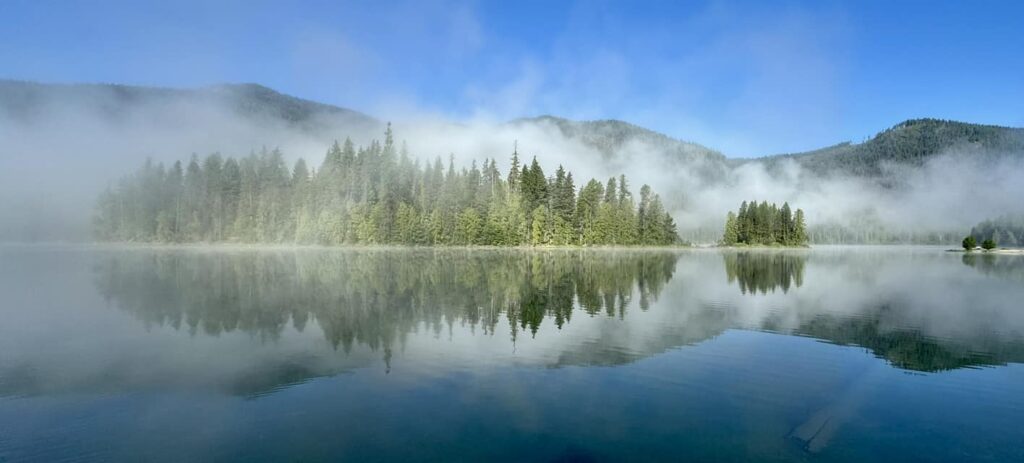
Bull Lake is the answer for travelers who specifically searched “private lake cabin Montana” and meant it.
The lake sits within the Kootenai National Forest — 2.2 million acres of national forest surrounding the water on every side. The shoreline is largely undeveloped: a mix of private cabin properties and national forest land, with no resort infrastructure, no marina building visible from the water, and no commercial waterfront development in sight from any point on the lake.
Motorized boat traffic on Bull Lake is minimal by the standards of any comparable Montana lake destination. The lake’s distance from major population centers and the absence of resort infrastructure keeps recreational use low — on most summer weekdays, the water is effectively yours. Even peak summer weekends rarely produce the motorized boat density that is routine at Flathead or Whitefish.
The private cabin rental experience at Bull Lake matches what the word “private” actually means: a stretch of shoreline that belongs to your rental, no neighboring structures visible from the water, minimal boat traffic on the lake’s surface, and the national forest beginning at the property line on every side.
Shangrilog on Bull Lake is the most complete private lake cabin experience available in Northwest Montana at any price point: 85 feet of private shoreline, a private dock extending into the lake, four bedrooms in a 3,000-square-foot handcrafted log home sleeping 10 guests, with the Cabinet Mountains visible in every direction and nothing commercial visible from the water.
Privacy rating: High — minimal boat traffic, largely undeveloped shoreline, national forest surroundings. Best for: Travelers who specifically want a private lake experience — solitude, minimal boat traffic, no resort infrastructure visible from the water. Extended stays, large groups, and travelers who’ve visited the famous Montana lakes and want something genuinely different.
Kootenai National Forest Remote Lakes — Very High Privacy
The Kootenai National Forest contains dozens of smaller, more remote lakes — accessible by Forest Service road or trail — that represent the highest privacy level available in Northwest Montana. These lakes have no private development, no boat traffic, and in many cases no other visitors on any given day.
Access to overnight lodging at these remote lakes is primarily through Forest Service cabin rentals bookable through Recreation.gov — rustic properties at $50–$100 per night with minimal amenities. The privacy is genuine and the experience is irreplaceable for travelers comfortable with backcountry conditions.
Privacy rating: Very high to absolute — undeveloped, minimal visitor traffic, true backcountry conditions. Best for: Experienced backcountry travelers who prioritize remote solitude over amenities. The highest-privacy Montana lake experience available.
For the complete guide to Kootenai National Forest cabin options, see Kootenai National Forest Cabins →
The Bull Lake Private Cabin Experience in Detail
Bull Lake’s privacy level is the result of specific geographic and regulatory conditions that distinguish it from every other accessible private lake cabin destination in Montana. Understanding why it’s private helps travelers understand what they’ll actually experience.
Why Bull Lake Is Private
National Forest ownership of surrounding land. The Kootenai National Forest owns the land surrounding most of Bull Lake’s shoreline. Forest Service management means no commercial development, no resort infrastructure, and no dense residential development on the non-private portions of the shoreline. The forest begins at the water on the non-private sections — not a manicured resort landscape, but old-growth conifer and mountain terrain.
Distance from major population centers. Bull Lake is 20 minutes north of Troy (population 900) and 50 minutes west of Libby (population 2,800). The nearest city of any size is Kalispell, over two hours away. This distance limits casual day-use traffic — the people on Bull Lake are almost exclusively guests at lakeside properties, not day visitors from nearby communities.
No resort infrastructure. There is no marina on Bull Lake. No boat rental concession. No resort hotel across the water. No commercial waterfront business of any kind visible from the lake’s surface. The absence of this infrastructure is what makes the privacy possible.
Limited total shoreline development. Bull Lake’s private development occupies a fraction of the total shoreline. The undeveloped portions are forest — visible from the water as unbroken treeline rather than docks and rooflines.
The Privacy of Shangrilog Specifically
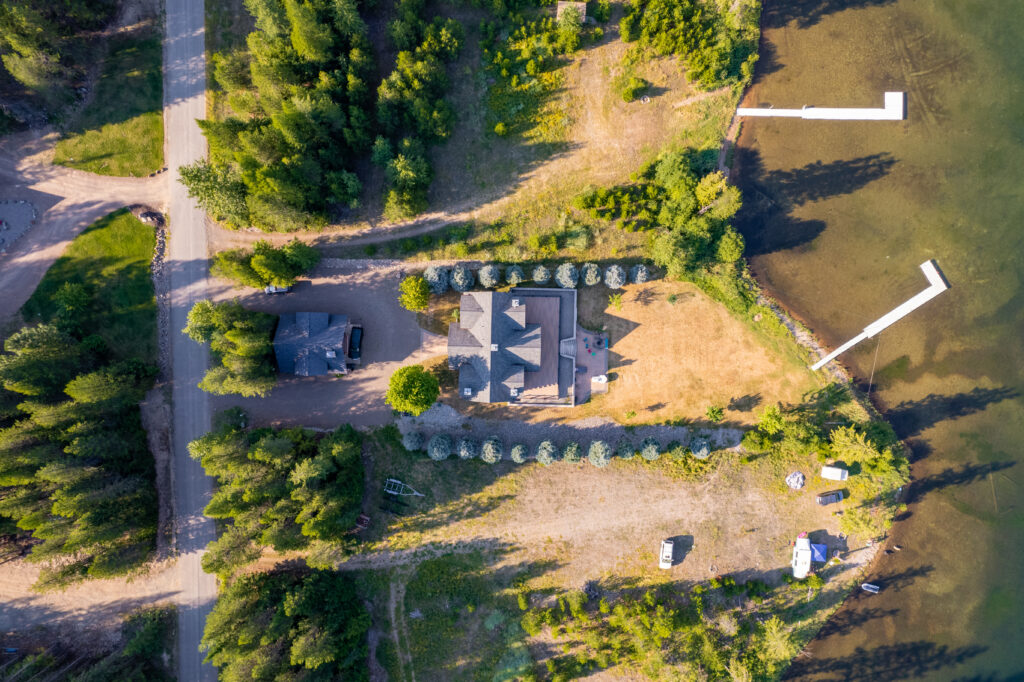
Within the Bull Lake rental market, Shangrilog’s specific position on the lake maximizes the privacy conditions:
85 feet of private shoreline. No neighboring properties share the shoreline within the rental’s boundaries. During your stay, that stretch of water is yours exclusively.
Private dock. The dock extends from the private shoreline into the lake — no shared dock structure, no coordination with neighbors, no marina schedule. The dock is available 24 hours.
Orientation and sightlines. The primary view from the cabin and dock faces the open lake and the Cabinet Mountains — the visual experience is lake and mountain, not neighboring structures and boat traffic.
National forest at the property line. Beyond the developed footprint of the property, the Kootenai National Forest begins — no roads, no structures, no other human activity visible in the surrounding landscape.
What Private Lake Cabin Privacy Actually Delivers
The Morning
A private lake cabin morning at Bull Lake is the experience the word “private” implies: 6 AM, your group on the dock or the deck, the lake surface entirely undisturbed, no boats, no voices from neighboring docks, no motors. The silence is active rather than passive — birds, water, wind in the trees, the occasional splash of a fish. Nothing else.
This morning is available at a famous Montana lake occasionally, in the shoulder seasons, in certain years. At Bull Lake, it is available every morning of a summer, fall, winter, or spring stay.
The Day
A day on a genuinely private Montana lake has a different structure than a day on a recreational lake. On Flathead or Whitefish in peak summer, the lake’s midday character is shared — boats crossing the open water, jet skis near the public access points, the general hum of recreational infrastructure. The private cabin is a retreat from the lake rather than an extension of it.
At Bull Lake, the lake’s midday character is yours. Kayaking across the open water without navigating around powerboats. Swimming off the dock without other swimmers approaching from the community beach. Fishing from the dock in the afternoon without interruption. The lake doesn’t become public during the day — it remains the private environment it was at dawn.
The Evening
Privacy changes Montana lake evenings most dramatically. The absence of boat traffic after dusk on a genuinely private lake produces a stillness that lakeside properties on busy lakes almost never achieve — the water surface settling into complete calm, the mountain reflection perfect, no motors in any direction. A fire at the shoreline in this silence, with the dark sky and the Milky Way overhead undimmed by resort lighting, is the Montana lake evening that most travelers imagine and few actually get.
Choosing a Private Lake Cabin in Montana: What to Verify
Ask About Visible Neighboring Structures
Ask the owner directly: “How many neighboring structures are visible from the dock or from the water?” At a genuinely private property, the answer should be “none” or “one, at significant distance.” If the answer involves counting neighbors, the privacy level is lower than the listing suggests.
Verify Boat Traffic Character
Ask: “What is the typical motorized boat traffic on this lake on a summer Saturday?” The answer tells you more about the actual privacy of the water than any listing description. At Bull Lake, the honest answer is: minimal, primarily fishing boats, rarely more than a handful across the entire day.
Confirm National Forest Boundaries
Properties adjacent to national forest land have a built-in privacy guarantee — the forest can’t be developed. Confirm whether the property’s non-lake perimeter abuts national forest, private land, or something else. National forest adjacency is the strongest structural privacy guarantee available in Montana.
Check for Shared Access Points
Ask whether any public access points — boat launches, fishing access sites, swimming areas — are located on or adjacent to the property’s shoreline. Public access points on private lake cabin frontage create the one condition that undermines even the most genuinely private property: strangers walking through your space to reach the water.
Private Lake Cabins Montana: Pricing by Privacy Level
The privacy premium in Montana’s lake cabin market is real but concentrated at the top end. Moving from a low-privacy lake (Flathead, Whitefish) to a high-privacy lake (Bull Lake) doesn’t require paying more — it typically requires paying significantly less.
| Lake | Privacy Level | Peak Nightly Rate | Per-Person (10 guests) |
|---|---|---|---|
| Flathead Lake | Low | $400–$800+ | $40–$80+ |
| Whitefish Lake | Low–Moderate | $350–$700+ | $35–$70+ |
| Lake Koocanusa | Moderate | $125–$275 | $13–$28 |
| Bull Lake (Shangrilog) | High | $175–$350 | $18–$35 |
| Kootenai NF remote lakes | Very high | $50–$100 (FS cabins) | Variable |
The privacy-price relationship in Montana’s lake cabin market is counterintuitive: the most private options are not the most expensive. The premium pricing at Flathead and Whitefish reflects the lakes’ fame and service infrastructure — not their privacy level. Bull Lake’s pricing reflects a less-famous destination with genuinely superior privacy at a lower cost.
Who Private Lake Cabins in Montana Are Right For
Travelers Who’ve Already Done the Famous Lakes
The most consistent profile of Bull Lake traveler: someone who visited Flathead or Whitefish on a previous Montana trip, experienced the beauty but also the crowds, and started searching for what Montana looked like before the resort corridor developed. Bull Lake is the answer to that specific search — not a consolation option but the destination that travelers find after understanding what they actually want.
Large Groups Who Need Both Space and Solitude
The combination of genuine privacy and large-group capacity is rare in Montana’s lake cabin market. At Flathead and Whitefish, properties large enough for 10 guests exist but sit at the top of premium markets in heavily used lake environments. At Bull Lake, Shangrilog provides 3,000 square feet sleeping 10 guests on 85 feet of private shoreline at a per-person cost of $18–$35 per night — space and privacy together at a price that makes the multi-night group trip financially practical.
Families with Children Who Want a Safe, Quiet Water Environment
Busy recreational lakes with motorized boat traffic are not ideal environments for families with young children who want to use the water freely. The anxiety of a child in the water on a lake with jet skis and powerboats passing is real and justified. Bull Lake’s low boat traffic and private shoreline access change the character of the water experience for families with children — the lake is genuinely safe for unstructured water play in a way that high-traffic lakes are not.
Writers, Artists, and Deep-Rest Travelers
The population of travelers who specifically want Montana lake solitude for creative work, extended reading, intentional disconnection, or recovery from burnout is significant and growing. The structural conditions at a genuinely private lake cabin — no ambient noise from neighboring activity, no boat traffic, uninterrupted natural soundscape — are the conditions this traveler needs. Bull Lake delivers them. Flathead and Whitefish do not.
Repeat Montana Visitors
Travelers who have made multiple trips to Montana and have seen the famous sights — Going-to-the-Sun Road, Glacier’s major trails, the Flathead Valley’s resort amenities — are the natural Bull Lake audience. They know what Montana’s landscape feels like and want more of it, not a different version of the resort experience they’ve already had. Bull Lake is Montana at the depth that repeat visitors are looking for.
Seasonal Privacy Guide at Bull Lake
Summer: Highest Use, Still Private by Montana Standards
Peak season brings the highest visitor volume to Bull Lake — but “highest volume” at Bull Lake means a fraction of the boat traffic that routine summer weekends produce at Flathead or Whitefish. Weekday mornings at Bull Lake in July are as quiet as fall mornings. Weekend afternoons are the busiest — a handful of fishing boats and possibly a kayak or two sharing the lake’s six-mile length.
The privacy of the shoreline doesn’t change seasonally — 85 feet of private shoreline is private in July exactly as it is in September.
Fall: Peak Privacy Season
September and October combine Bull Lake’s year-round privacy with the additional conditions that make it the best season: boat traffic drops to near zero after Labor Day, the western larch color transforms the hillsides above the lake, and the fishing improves as water temperatures fall. The fall privacy experience at Bull Lake — the lake entirely quiet, the gold hillsides reflected in the water, no other activity visible in any direction — is the Montana lake cabin experience that travelers describe when they explain why they keep returning.
Winter: Complete Solitude
Winter on Bull Lake produces conditions that are genuinely uncommon at accessible Montana lake cabin destinations: complete solitude, the lake surface either glassy open water or frosted with thin ice at the edges, no boat traffic of any kind, and the surrounding forest silent under snow. Shangrilog’s year-round operation makes this experience available as a deliberate choice rather than an accident of booking.
Spring: Recovery Season
Spring brings snowmelt, cold water, and the return of wildlife to the shoreline — but minimal human traffic. Spring at Bull Lake is the emptiest human season and the most active wildlife season. The privacy of a spring stay at Bull Lake approaches the character of a remote wilderness stay while maintaining the amenity level of a fully equipped lakefront property.
Frequently Asked Questions
What makes a Montana lake cabin genuinely private vs. just “private”?
Genuine privacy at a Montana lake cabin requires five conditions: no neighboring structures visible from the water, no shared shoreline access, minimal boat traffic, no road or path between the cabin and the water, and no commercial infrastructure visible from the property. Most “private” Montana lake listings satisfy one or two of these conditions. Bull Lake’s Shangrilog satisfies all five. For the full privacy evaluation framework, see the section above.
Which Montana lake has the most private cabin rentals?
For accessible private lake cabin rentals with full amenities, Bull Lake offers the highest privacy level in Northwest Montana. For the most remote and highest-privacy experience at any amenity level, Kootenai National Forest remote lakes accessible by Forest Service cabin rental through Recreation.gov offer near-absolute solitude. For a full Montana lake comparison, see the Montana Lake Vacation Rentals guide →
How is Bull Lake different from Flathead or Whitefish for privacy?
Flathead and Whitefish are heavily developed recreational lakes with dense shoreline construction, significant motorized boat traffic in peak season, and commercial infrastructure visible from the water. Bull Lake has a largely undeveloped shoreline within the Kootenai National Forest, minimal boat traffic, no resort infrastructure visible from the water, and private cabin rental properties with genuine private shoreline access. The privacy difference is structural — not a matter of which cabin you book but which lake you choose.
What is the best season for the most private Montana lake cabin experience?
Fall (September–October) at Bull Lake delivers the highest overall combination of privacy, natural beauty, and weather quality. Boat traffic drops to near zero after Labor Day, western larch color peaks late September through mid-October, fishing improves, and rates drop 20–30% from August peaks. Winter offers complete solitude but cold conditions. Summer offers full water access with the lake’s year-round privacy character. For seasonal detail, see the section above.
Are private lake cabins in Montana available year-round?
Most Montana lake cabin properties — particularly at Flathead and Whitefish — close seasonally in fall. Shangrilog on Bull Lake operates year-round with full winterized access, year-round private dock availability, and winter activities including ice fishing and Turner Mountain skiing. This year-round operation is a specific advantage for travelers who want the private lake experience in off-peak seasons.
What is the per-person cost of a private lake cabin in Montana for a large group?
At Shangrilog on Bull Lake — 3,000 square feet sleeping 10 guests — the per-person nightly rate at $175–$350 per night runs $18–$35. Comparable private lake cabin properties at Flathead and Whitefish for similar group sizes run $40–$80+ per person per night. For groups of 8–10, the total accommodation cost difference over a five-night stay can exceed $2,000 in favor of Bull Lake. For a complete pricing comparison, see Montana Lake Vacation Rentals →
Is Bull Lake truly private or just less crowded?
Both — but the distinction matters. Bull Lake is genuinely less crowded than Flathead or Whitefish by a significant margin. And Shangrilog’s specific position on the lake — 85 feet of private shoreline, private dock, national forest on every non-water boundary — delivers true privacy conditions as defined above. The combination of a less-crowded lake and a genuinely private property produces an experience that neither condition alone would fully provide.
What waterfront access does a private lake cabin at Bull Lake include?
Shangrilog includes 85 feet of private Bull Lake shoreline, a private dock extending into deep water with ladder access, gradual shoreline entry for swimming at the cabin level, and direct kayak and paddleboard launch access from the dock. For the complete guide to private dock access in Montana, see Montana Cabins with Private Dock →
Plan Your Private Montana Lake Cabin Stay
Montana has private lake cabin options at every price point and privacy level — from Forest Service rustic cabins on remote mountain lakes to fully equipped lakefront properties with private docks and mountain views. The key is matching the privacy level you actually want to the destination that delivers it.
For the travelers who specifically want what the phrase “private lake cabin Montana” implies — a cabin on quiet water, surrounded by wilderness, without the resort infrastructure and recreational traffic that the famous Montana lakes now carry as a permanent condition — Bull Lake is the answer.
For the finest private lake cabin in Northwest Montana — high-privacy setting within the Kootenai National Forest, 85 feet of private shoreline, private dock, 3,000 square feet sleeping 10, wood-burning fireplace, hot tub facing the lake, and year-round availability — Shangrilog is ready.