Bull Lake Cabin in Troy, Montana
Huckleberries grow wild across the Kootenai National Forest, and the country around Bull Lake is squarely in their range. They ripen somewhere in the back half of summer, low slopes first and high ground later, and the timing moves by weeks from one year to the next depending on snowpack and heat.
Picking them is free, it needs no equipment beyond a container, and the Forest Service sets personal-use collection limits that most visitors will never come close to. What it does need is a little patience and a working respect for the fact that you are gathering the same food a grizzly is gathering.
This guide covers when to go, how to read the country for likely ground, the rules that apply on national forest land, and how to pick safely in bear country. What it does not include is a list of good patches, and there’s a reason for that further down.
Your Montana story begins here
Check your dates and reserve your stay along 85 feet of private Bull Lake shoreline.

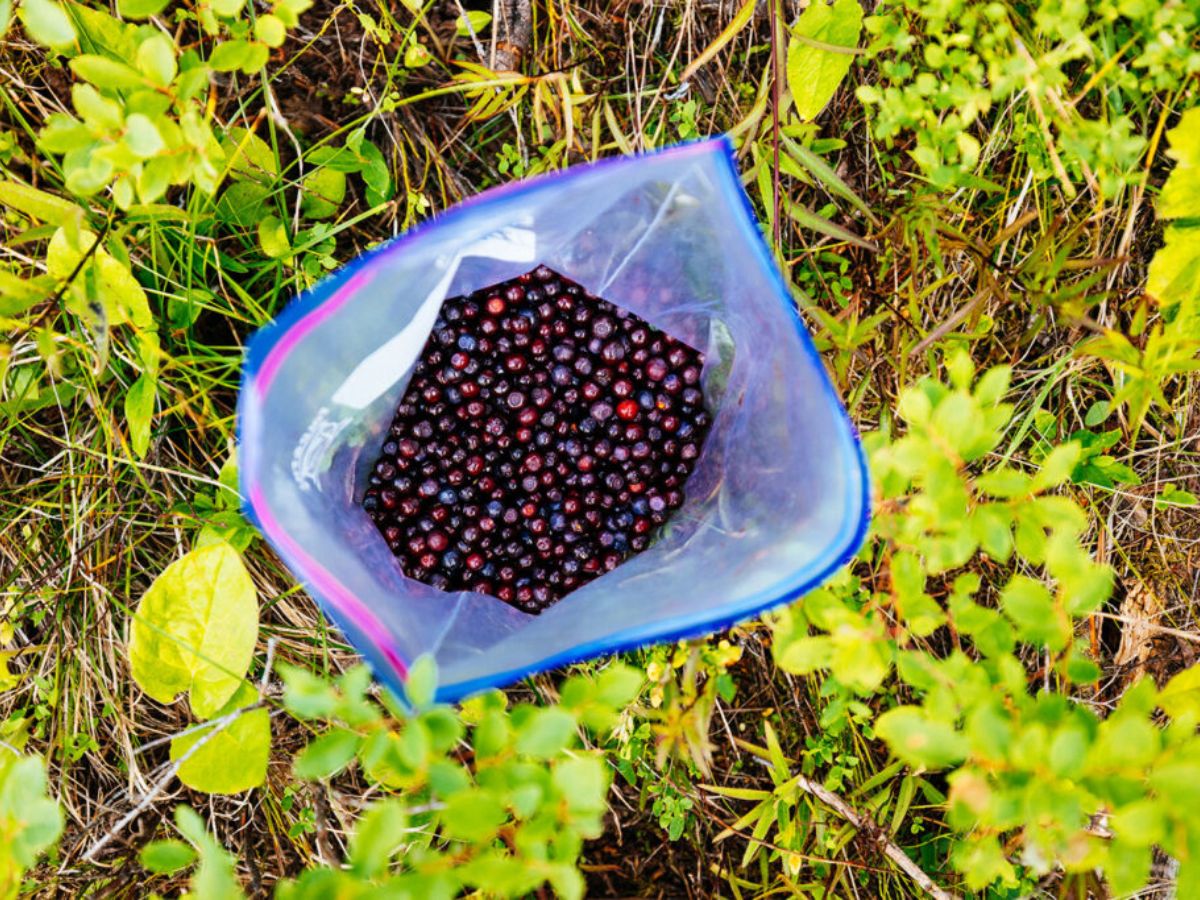
Mountain huckleberries are Vaccinium — the same genus as blueberries, but a different animal in the hand. They grow one berry at a time where the leaf meets the stem, rather than in clusters, on a low woody shrub that spreads from underground stems. Ripe ones run deep purple-red through to nearly black, and they are soft enough to crush if you close your hand.
Attempts to farm them commercially have never really worked. The shrubs depend on soil conditions and mycorrhizal relationships that resist transplanting, which is why huckleberries are still gathered wild in Montana rather than grown in rows. It is also why locals treat a productive patch as something close to private property.
If you cannot identify a berry with confidence, do not eat it. Several wild berries in this country are unpleasant and a few are genuinely toxic — baneberry, which grows in a cluster on an upright stalk and has a glossy skin, is the one to learn first. Pick with someone who knows the plant, or carry a regional field guide, and leave anything you’re unsure about on the bush.
There is no fixed date, and anyone who gives you one is guessing. Ripening tracks elevation and aspect: lower, south-facing slopes come on first, and the high shaded ground can run weeks behind. A heavy snow year pushes everything later. A hot dry summer can bring it forward and shorten the window.
In practice the season runs through the back half of summer and can hold into early autumn at elevation. The useful approach is to start low and work uphill as the weeks go on — if the berries at road level have gone soft and dropped, there is probably still good picking a thousand feet above you.
Call ahead if you are planning a trip around it. The Kootenai National Forest district offices can tell you how the season is running, and they will give you a straighter answer than any calendar.
Huckleberries want mid-elevation ground with light. Look for the edges rather than the middle of things: old burns and cutover ground that has opened the canopy, the margins of forest roads, slopes where the timber is thin enough for sun to reach the understory. Dense mature forest with a closed canopy produces plants but very little fruit.
Aspect matters as much as elevation. North-facing slopes hold moisture and ripen late; south-facing ground dries out and ripens early, sometimes too early in a hot year. A mixed day working both gives you better odds than committing to one.
You will not find a list of named patches here, and you should be sceptical of any site that gives you one. Huckleberry ground is genuinely finite, it is shared with wildlife, and a patch that appears in a travel article stops producing for anyone within a season or two. Locals guard specific spots for exactly that reason, and a guest who asks around politely and puts in a morning of looking will generally do better than one following directions off the internet.
Ready to plan your Montana escape?
Call us at (406) 295-0100 and we’ll help you find the right dates for your stay at Shangrilog.
The Kootenai National Forest manages huckleberries as a special forest product, alongside mushrooms, beargrass and evergreen boughs, and has published collection limits, fees and permit requirements for each. Those figures change, so read them on the Forest’s own page before you go rather than taking a number off a blog — this one included.
The broad shape of it: limits are set for personal use and apply per adult per calendar year. Gathering any quantity to sell is commercial harvesting, which needs a different permit and a different fee. If you are picking a few quarts for the freezer you are comfortably in personal-use territory, but the Forest is the authority on where that line sits, not us.
Two other rules worth knowing before you set out:
This is the part that matters most. Huckleberries are a major late-season food for both black bears and grizzlies, and the Cabinet-Yaak country holds both. When you walk into a good patch in August you are walking into a feeding area, and you should assume something else is already using it.
Carry bear spray somewhere you can reach it in a second — a hip holster or chest harness, not the bottom of a pack you set down to pick. Make noise as you move, and keep making it: picking is quiet, head-down, stationary work, which is exactly the profile that leads to surprising an animal at close range. Do not wear headphones. Pick in a group, keep the group together, and keep children close.
If a bear is in the patch, the patch belongs to the bear. Back out calmly, give it room, and find other ground — there is always other ground. Montana Fish, Wildlife & Parks publishes practical guidance for recreating in bear country that is worth reading before the trip rather than in the car park.
Hand-picking is slow and it is the right way to do it. Berry rakes strip leaves and damage the woody growth that fruits next season, and the Forest sets conditions on what you may use — check the collection limits page before you bring one.
Take a container you can hang or belt, so both hands stay free, and something rigid rather than a bag: huckleberries crush under their own weight surprisingly fast. Work a bush from underneath, where the ripe fruit hides in the shade of the leaves. Leave the green ones and the hard red ones; they do not ripen off the plant.
Most people pick far less than they expect on a first outing. A quart is a decent morning. If you come back with more than that you have found good ground, and the correct response is to keep quiet about it.
Huckleberries freeze well and they freeze best unwashed, spread in a single layer until solid and bagged afterwards. Washed berries clump into a brick. If you plan to cook or freeze what you pick during your stay, call us on (406) 295-0100 before you travel and ask what’s in the kitchen — it is a quicker answer by phone than a guess from a packing list, and it decides whether you bring containers with you.
The deck is a reasonable place to sort a morning’s picking, with the Cabinet Mountains in front of you and nothing much to do for an hour. Pair a picking morning with a walk — our Cabinet Mountains Wilderness day hikes guide covers routes in the same country, and the Yaak Valley runs through forest of much the same character further north.
Forest roads in this district change status regularly, and the last two winters have been hard on them. Storm damage, salvage operations and fire closures have all shut roads here, some of them for more than one season, and a road that was open on your last visit may not be open now.
Check the Kootenai National Forest alerts page shortly before you travel. As one current example, the road into Ross Creek Cedars has been closed to motor vehicles under a Forest Order following flood and landslide damage — a closure with a multi-year horizon on one of the better-known access roads in the area. Assume nothing, and check the day before rather than the month before.
Come see it for yourself
Shangrilog sleeps up to 10 on Bull Lake in Northwest Montana. When you’re ready to plan a visit, we’d love to host you.
There is no fixed date. Ripening runs through the back half of summer and can hold into early autumn at higher elevation, with lower south-facing slopes coming on first. Snowpack and summer heat move the window by weeks from year to year. Call a Kootenai National Forest district office for how the current season is running.
The Forest sets collection limits, fees and permit requirements for huckleberries as a special forest product, with limits applying per adult per calendar year for personal use. Gathering to sell is commercial harvesting and requires a different permit. Check the Forest’s non-wood forest products page for the current figures before you pick.
We do not publish specific patches, and we would encourage you to be wary of sites that do — named patches get stripped within a season or two, and the ground is shared with wildlife. Look instead for mid-elevation ground with open canopy: old burns, cutover areas and the margins of forest roads.
It is, with preparation. Huckleberries are a major late-season food for black bears and grizzlies, so assume a good patch is already in use. Carry bear spray where you can reach it, make noise continuously, do not wear headphones, pick in a group, and leave the patch to any bear that is already there.
Mountain huckleberries grow one berry at a time where the leaf meets the stem, on a low woody shrub, and ripen deep purple-red to nearly black. Berries growing in clusters on an upright stalk are something else — baneberry, which is toxic, grows that way. If you cannot identify a berry with confidence, do not eat it.
Yes — the cabin sits in the middle of huckleberry country, with national forest ground in every direction. Check the Forest Service collection limits and current road alerts before you go, and call us on (406) 295-0100 if you want to know what is in the kitchen for cooking or freezing what you bring back.